EdTechCase study · 2025
Feedback
An AI-assisted feedback tool for workplace supervisors, built to help them give timely, clear and genuinely useful feedback to the students they mentor, without adding to their workload.

Problem
In Work-Integrated Learning, workplace supervisors often give feedback that is rushed, unclear, and not developmentally useful. Time constraints, role ambiguity, limited pedagogical training, and the emotional difficulty of delivering corrective feedback all push in the same direction. What reaches students ends up generic, compliance-oriented, and hard to act on.
My role
Product and interaction design, on a small two-person team. I handled the research synthesis, information architecture, interaction, visual system, and the prototype build.
Outcome
A working AI-assisted prototype, with a set of features that support both the supervisors giving feedback and the students receiving it. The project was shortlisted for and presented at the WIL Symposium and the CRADLE Symposium, in front of scholars working in the Work-Integrated Learning space, who responded well to the approach we had taken.
How might we help time-poor supervisors give feedback that is timely, clear and genuinely useful, without adding to their load or taking away their judgement?
The five barriers we found
Role ambiguity
Supervisors juggle being managers, mentors and coaches, often without clear institutional guidance on learning objectives or assessment criteria. That ambiguity trickles down into vague feedback.
Time constraints
Supervisors are time-poor, and feedback gets squeezed into the gaps between their core responsibilities. So it ends up superficial, or it arrives too late to be useful.
Limited training
Many supervisors are strong practitioners but not trained educators. Their feedback tends to stay at the task level, telling a student to fix this part, rather than building the judgement they can carry forward.
Emotional weight
Giving corrective feedback is emotionally charged. Supervisors do not want to damage the relationship, so they soften the critique or avoid the harder conversation altogether.
Fragmented tools
The existing tools, the forms, checklists, training modules and LMS systems, are process-heavy and compliance-driven. They add admin without helping in the actual moment of writing feedback.
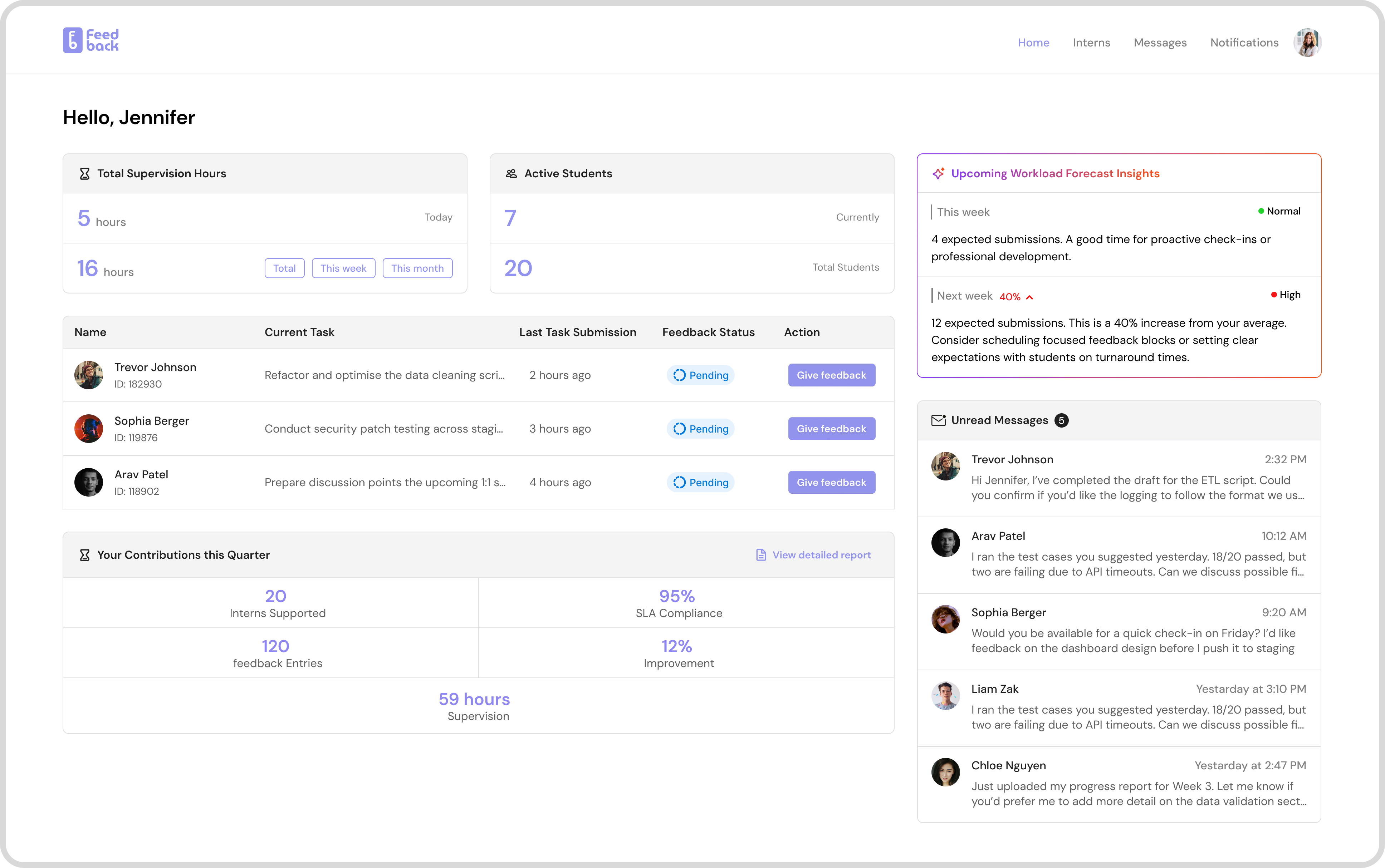
The dashboard, annotated. Tap a pin to read the decision behind it.
feedback · supervisor dashboard
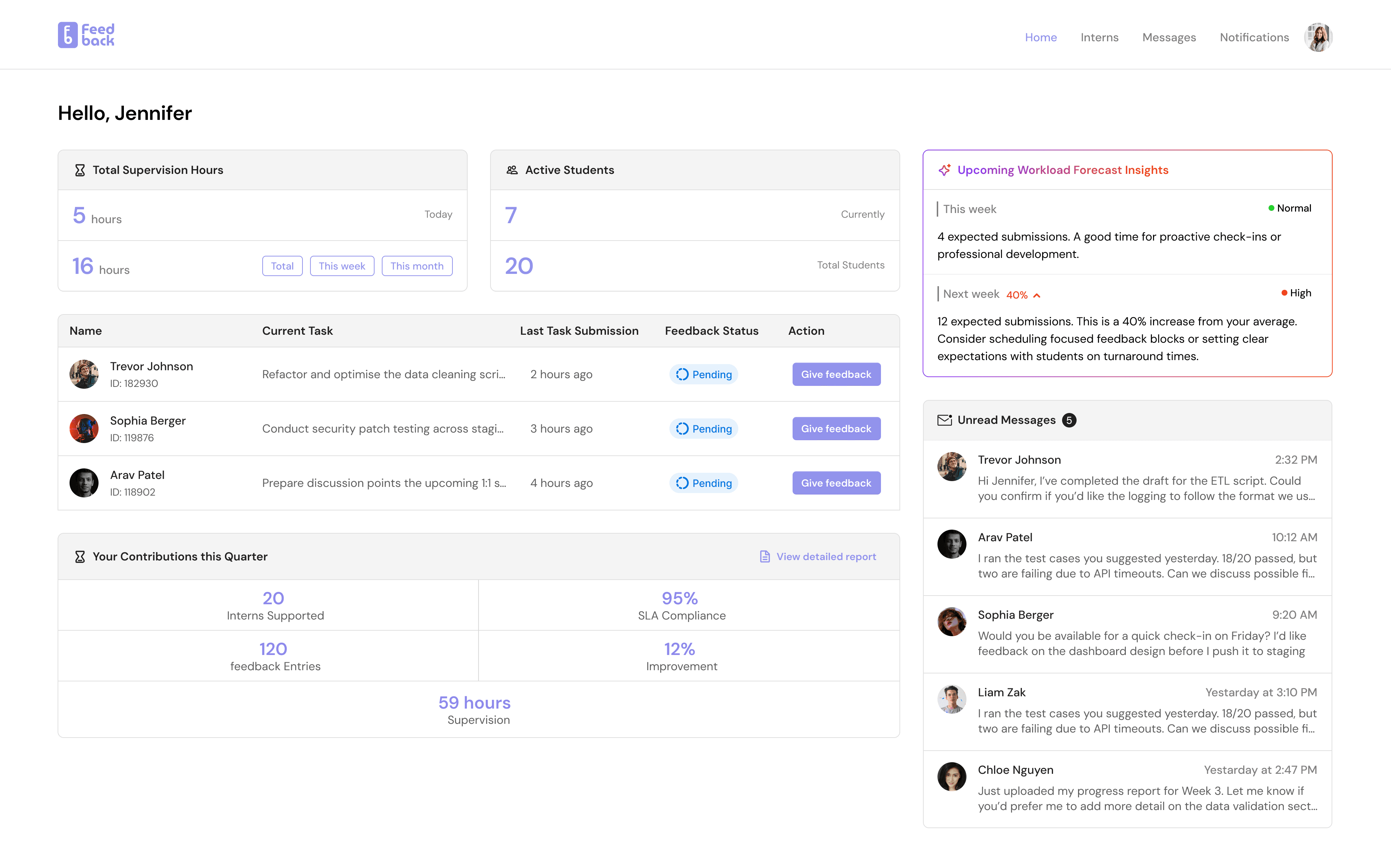
The dashboard, annotatedFive design decisions live on this screen. Swipe this card, or tap a number on the dashboard, to zoom into each one.
The reframe
An earlier project of ours focused on the student side of the Work-Integrated Learning experience: helping students read, seek and act on the feedback they were given. We kept running into the same wall. It did not seem to matter how good a student got at using feedback if the feedback itself was rushed, generic, or quietly softened to keep things comfortable. That is what made me turn the question around, and start looking at the supervisors giving the feedback rather than the students receiving it.
Method
We ran the project as a hybrid of Design Thinking and Lean UX. Design Thinking gave us a way to sit with the human problem and understand it properly, and Lean UX kept us making and testing in short loops instead of writing long specification documents. We could not interview supervisors directly, so we validated by proxy, checking each concept against WIL research, established feedback frameworks, and university guidance. The methodology diagram is adapted from Galvin (2019).
Research became a spec
We turned the research synthesis into a set of explicit requirements, so every screen in the product can be traced back to something we found in the research.
F1
See every submission and its status in one dashboard.
F2
Write feedback, track pending items, mark complete.
F3
AI analyses feedback as written and suggests clearer phrasing.
F4
A private Notes space for observations per intern.
F5
Messages for feedback not tied to a single submission.
F6
AI surfaces relevant notes while composing.
Plus non-functional rules: minimal steps, privacy by default, a neutral AI tone that never overrides the supervisor, and continuity across sessions.
The four flows
1 / 4
feedback · smart feedback
Smart Feedback
F3 answerslimited training
The student's work and the feedback box sit side by side. Before you start, a short goal modal asks for the formality, the context and the impact you are going for. Then, as you write, the AI flags a weak sentence and offers a clearer version with Accept and Dismiss, so the guidance arrives right in the moment you are writing.
Six decisions, each answering a barrier
1A focused feedback layerfragmented tools
Task assignment and compliance are already handled well by tools like Jira, Asana and existing LMS systems. The real gap is the quality and emotional safety of the feedback itself, so we kept the scope narrow and designed deeply for that one moment, letting the tool sit alongside whatever a team already runs on.
2Micro-learning built into the worklimited training
The goal modals nudge a supervisor to clarify their intent before they write, and the AI quietly models clearer, more developmental phrasing as they go. The learning happens inside their normal workflow, so they build the skill just by using the tool.
3AI kept in a supporting roleemotional weight
The AI never auto-sends or overwrites anything a supervisor writes. Its suggestions are optional, clearly labelled and always editable, and the tone stays neutral. Feedback is already emotionally loaded, so the aim was to give supervisors more confidence while they stay fully in control.
4Notes as a quiet knowledge baserole ambiguity
Supervisors already carry informal notes about their interns in their head. We turned that into a private, structured space, tagged by theme, that the AI can draw on later. It helps them keep track across several interns, and it lets the AI personalise its suggestions from real history built up over time.
5Messages that work like emailfragmented tools
Performance and behavioural feedback benefits from being slower, documented and revisitable, so we structured Smart Messages like email, with subjects, longer bodies and saved drafts. It still feels modern and approachable, while encouraging a more considered message than a quick chat would.
6Recognise the supervisor's efforttime constraints
Supervisors invest real time and emotional energy in mentoring, on top of their actual job. The contributions dashboard and the AI-drafted quarterly report turn that activity into clear, shareable evidence for their appraisals. It gives something back to the person doing the work.
What's still open
I want to be straight about the limits. This has not been piloted with real industry supervisors, so everything here is reasoned from research rather than proven in the field. The parts I would test next are how it adapts across different disciplines, whether it can support in-person feedback and not only the written kind, and how it would really sit inside the tools a workplace already runs on. What I took away is a clearer sense of what human-centred AI can look like when you design it for the people giving feedback, not only the ones receiving it.